Global Weirding: Water Watch
Well, laws banning global warming, passed in the early years of the last decade (2012-15) by republican legislatures in the south (Florida, Tennessee, North Carolina, Louisiana) having failed to have any effect (except for honest state employees being punished for using the term), you might think we are ready to accept drought and sea level rise as reality. Here in California, in the wake of Covid, a good governor is subject to recall, and is reluctant to slow the expropriation of desperately needed Northern California water to keep Hollywood and Orange County swimming pools full. New research shows that polar and glacial melting is hastening sea level rise faster – 13% faster – than anticipated. Not a big deal on our coast, where subduction bumps us up 30 feet every 100,000 years or so (we're overdue). An estimated 10% of the world's population can expect to be flooded out of their homes (and cities!) in this century. King tides during the winter of 2020-21 washed higher onto our beaches than in the last 25 years. Marginal sea level rise in our creeks to about the level we now see storm surges reaching (so they'll be reaching that much farther upstream).
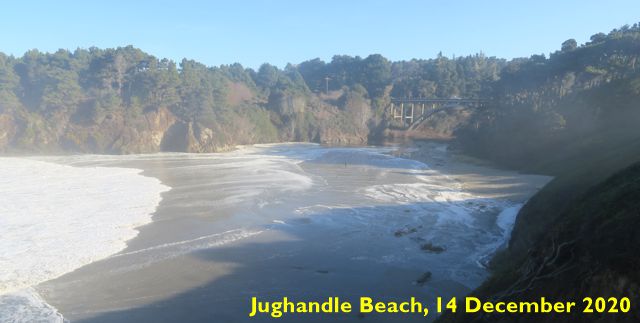
For a good rain year, we have to look back to Winter 2016-17, but at the end of rain year 2020-21 we have had slightly over half of our 20th Century seasonal average rainfall – 20 inches this last winter against an average of 39". Last year was also below average. Wells in Caspar are already going dry; due to water emergencies along the Coast, trucked in water costs a dollar a gallon. Inland, reservoirs are half full, and the forests are tinder dry. Climatologists assure us this is likely the shape of our water future. How can we learn to live well with the reduced rainfall that appears to be our share of Global Weirding? Climate-change deniers, already confused about the difference between weather and climate and preversely invested in the industries that cause climate change, often point to anomalous weather (cold snaps in Manhattan, rainy winters in the middle of a drought), but the planet's testimonials, from last year's worst California fire season ever to Superstorm Sandy tell a different story.
Water is at the center of these stories, and as a coastal community, water must be a primary consideration in any discussion about resilence. We Casparados are not alone; drought refugees and water wars are a global phenomenon. We have enjoyed an unprecedented long holocene era of clement weather, but now, with populations increasingly living close to waterways, water use up, and rainfall down, we must get serious about water conservation. Here, below, are many resources to help us get smart with our water.
This page is maintained by Michael Potts with help from Sienna Potts, Judy Tarbell, and interested contributors from all over.
THANK YOU
and keep those great suggestions coming!
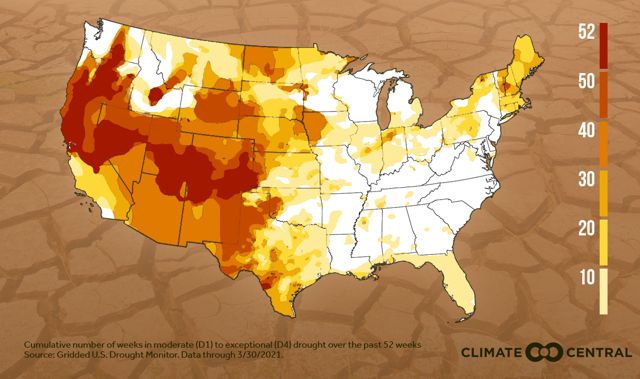
Cumulative weeks of drought. Caspar sits right at the top edge of the 52 weeks – 4+ years!
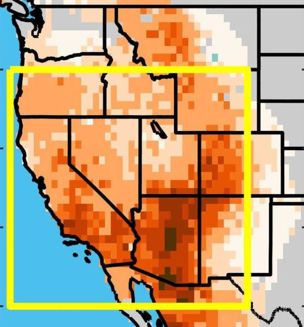 | An April 2020 article in Science notes a large contribution from anthropogenic warming is resulting in an "American Megadrought" in the western states. [source] |
|
USEFUL WEBSITES
Water Conservation and STEM
The popularity of STEM learning has the potential to aid water conservation efforts by engaging young people to make a difference in our current and future water usage. Water is a finite resource, and taking steps to conserve it, both through everyday actions and government intervention, can ease the current pressure facing our freshwater resources.
Cypresswood Water Conservation Garden
Using Drinking Water on Your Yard? How to conserve water and keep your garden healthy – how one community is addressing their issues – from East Texas, where the drought is also acute. Supported by the local water agency and volunteers.
Reducing water consumption
23 eco-friendly tips for reducing water consumption in (and outside) the home, 12 May 2023
Water Conservation Throughout the Home
Today’s modern household uses water for myriad purposes. Everything from cleaning dishes and taking showers to doing loads of laundry and washing the car can add up to several gallons or even hundreds of gallons of water used every month. Conserving the amount of water used at home will not only help to keep your water bill lower, but it’s also better for the environment. Found by Shannon Boyd while researching water for her Earth Science class, 5 December 2017
Water Conservation Tips
Includes an interesting chart showing water usage by country: USers consume 575 liters/day; in the UK, it's 149 l/d; Haiti and Ethiopia, 15 l/d. Found while helping her daughter Sofia research water by Katie Stevens, Pensacola, Florida, 13 March 2017, updated 2 August 2023
Water Conservation for Kids
Medford Water Commission's page is directed toward younger water users.
Hub Post: 50 Useful Water Tips
Proposed by Edelyn Cali, 15 January 2020
Public Records Review: Water Tips and Facts
43 More Water Tips (some overlap) and thoughts about modern habits, garden design, and more. Proposed by Edelyn Cali, 15 January 2020
Occidental Arts and Ecology Center (OAEC) WATER Institute
Promote understanding of the importance of healthy watersheds to healthy communities. Building upon OAEC's many years of work to protect Coastal California’s watersheds, the WATER Institute promotes a vision of restoring and protecting all watersheds, or "Basins of Relations," utilizing a framework of regenerative water-use practices known as Conservation Hydrology.
The Water Page -- Ecological Sanitation
Incorporates The African Water Page.
Water Footprint website -- lots of useful resources
20 Ways to Conserve Water at Home
One more water conservation article, updated 1 January 2020, proposed by Melissa Davenport, 3 August 2018
Defending Water for Life
Details Alliance for Democracy efforts to keep water resources in the public trust. Summarizes the history of the struggle to keep "Water for People and Nature" in the U.S. and around the world. This national campaign supports state-level work to protect water, including developing local resolutions against corporate personhood.
Stockholm International Water Institute
A policy institute that seeks sustainable solutions to the world’s escalating water crisis. SIWI manages projects, synthesizes research and publishes findings and recommendations on current and future water, environment, governance and human development issues.
ARTICLES ON THE WEB
100+ Incredible Ideas to Conserve Water at Home [A Life-Changing Guide]
Do We Need a Local Water Movement?
Dr. Peter H. Gleick, the co-founder and president of the Pacific Institute, writes:
Our major cities long ago outgrew their ability to provide enough food for the - sometimes - millions of people living in them, and they long ago outgrew their ability to provide enough water with purely local resources. New York City relies on water from upstate New York. Los Angeles relies on water from northern California and the Colorado River. San Francisco moves water from the Sierra Nevada. Even ancient Rome built aqueducts to move water long distances to supply the needs of the city when it outgrew local springs.
So when I call for a "local water" movement, I do not mean cities must shrink, or cut off the movement of water from neighboring watersheds. But a local water movement would lead to increased efforts to use local resources more effectively, to treat and reuse water once it has been brought into a region, to minimize the broader environmental consequences of water use and management, and to give priorities to local actions and management.
5 Documentaries You Must See to Understand the Water Crisis
Before rushing out to see a water movie, check out this thoughtful article.
Where are the world's water stresses?
Water Footprint's WaterPub is the world’s largest repository of water footprint publications.
VIDEOS
Water -- Localization vs Globalization/Corporate control
Maude Barlow tells us why globalization of water is such a disaster. She urges that water be for all, the haves and the have-nots alike, through careful, sensible measures. Her idea is that those with water surpluses must be the ones to start making sense. "Imperatives: cooperation, sustainability, public stewardship ... water could be our teacher, and a gift to humanity. "
Could Drinking Water Scarcity Lead to Ecological Crisis?
BOOKS
Cadillac Desert: The American West and Its Disappearing Water - Marc Resiner, Viking (ISBN 0-14-017824-4)
Introduction to Water in California (California Natural History Guides) - David Carle, University of California Press; 2 edition (February 20, 2009), ISBN 978-0520260160
The food each of us consumes per day represents an investment of 4,500 gallons of water, according to the California Farm Bureau. In this densely populated state where it rains only six months out of the year, where does all that water come from? This thoroughly engaging, concise book tells the story of California's most precious resource, tracing the journey of water in the state from the atmosphere to the snowpack to our faucets and foods. Along the way, we learn much about California itself as the book describes its rivers, lakes, wetlands, dams, and aqueducts and discusses the role of water in agriculture, the environment, and politics. Essential reading in a state facing the future with an already overextended water supply, this fascinating book shows that, for all Californians, every drop counts. A new preface on recent water issues brings the book up to the minute.
The Great Thirst: Californians and Water - A History - Norris Hundley, Jr., University of California Press; (May 7, 2001) ISBN 978-0520224568
The story of "the great thirst" is brought up to date in this revised edition of Norris Hundley's outstanding history, with additional photographs and incisive descriptions of the major water-policy issues facing California now: accelerating urbanization of farmland and open spaces, persisting despoliation of water supplies, and demands for equity in water allocation for an exploding population. People the world over confront these problems, and Hundley examines them with clarity and eloquence in the unruly laboratory of California.
The obsession with water has shaped California to a remarkable extent, literally as well as politically and culturally. Hundley tells how aboriginal Americans and then early Spanish and Mexican immigrants contrived to use and share the available water and how American settlers, arriving in ever-increasing numbers after the Gold Rush, transformed California into the home of the nation's preeminent water seekers. The desire to use, profit from, manipulate, and control water drives the people and events in this fascinating narrative until, by the end of the twentieth century, a large, colorful cast of characters and communities has wheeled and dealed, built, diverted, and connived its way to an entirely different statewide waterscape.
The King Of California: J.G. Boswell and the Making of A Secret American Empire - Mark Arax, PublicAffairs (February 15, 2005), ISBN 978-1586482817
This meticulous narrative of the rise of the cotton magnate James G. Boswell begins in the nineteen-twenties, when his family was driven from Georgia by boll-weevil infestations and brought its plantation ways to California's San Joaquin Valley. Not to be defeated by nature again, the Boswells leveed and dammed Tulare Lake, the largest body of fresh water west of the Mississippi, to the point of extinction. In its six-hundred-square-mile basin they grew cotton, while in Los Angeles office towers they built one of the country's largest agricultural operations, swallowing small farms and multimillion-dollar subsidies with equal vigor. Arax and Wartzman strive for evenhandedness but acknowledge the costs of Big Ag – such as evaporation ponds with selenium levels so high that ducks are born with corkscrewed beaks and no eyes, and the recurrent "hundred-year floods," stubborn attempts by the old lake to reassert itself.
You may never have heard of him, but J. G. Boswell controls the biggest farming empire in America. In the early part of the twentieth century, his family moved from Georgia to California, where they drained one of the country's biggest lakes, Tulare Lake, and planted cotton. Soon their cotton empire became the richest and most technologically sophisticated on the planet. This book is many stories, all rolled into one epic. It's the story of the Boswells from the 1800s to the present day; of cotton farming in America; of California itself; and of the evolution of race relations as the country dragged itself out of the era of slavery and, not at all smoothly, into the modern era. Written in a lively style that matches the bigger-than-life qualities of its subject, the book is far more exciting than you might think the story of a cotton farmer would be. With proper marketing, it could smash through genre barriers and become the Seabiscuit of agricultural biography!
--David Pitt
Copyright © American Library Association. All rights reserved --This text refers to the Hardcover edition.
Blue Covenant: The Global Water Crisis and the Fight for the Right to Water – McClelland & Stewart, Toronto (October 16, 2007) ISBN 978-0-7710-1072-9.
Globalization of Water: Sharing the Planet's Freshwater Resources -- Wiley-Blackwell, 2008, ISBN: 978-1-4051-6335-4, Hardcover, 232 pages
GOT OTHER RECOMMENDATIONS?
This is a HUGE subject, and the more we learn, the better we will handle our own commons and stewardship. Send recommendations to the keeper of this page at michael (at) casparinstitute.org
originally posted 21 August 2010 by Michael Potts, updated 25 July 2019
12,481 visitors since 21 Aug 2010
|